


















Smart Meters: How They Work & What They Do
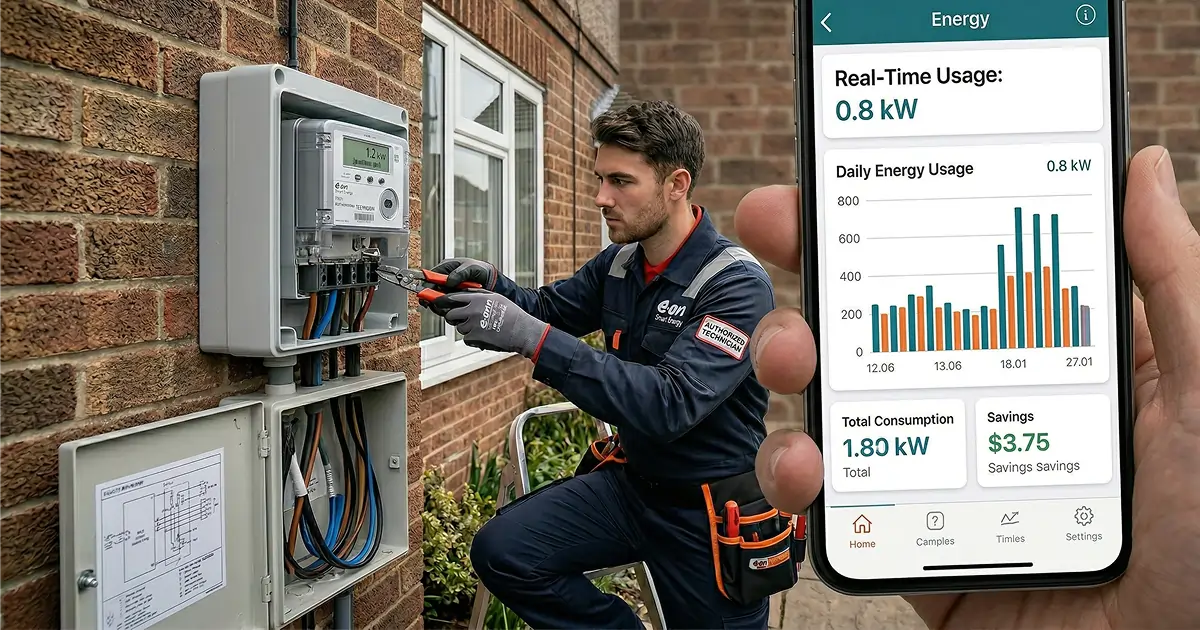
If you live in the United States, there’s a 75% chance you already have a smart meter on the side of your house — and you may not even know it. Smart meters have quietly replaced the old spinning-disk analog meters at over 115 million homes and businesses, fundamentally changing how electricity is measured, billed, and managed.
Here’s what your smart meter does, how it works, and — most importantly — how you can use it to lower your electricity bill.
Smart Meter vs. Analog Meter
| Feature | Analog (Legacy) Meter | Smart Meter |
|---|---|---|
| Display | Spinning disk + mechanical dials | Digital LCD screen |
| Data recording | Total cumulative kWh only | 15-minute interval data |
| Communication | None — requires human reader | Wireless (RF mesh or cellular) |
| Reading frequency | Once per month (manual) | Continuous (every 15 minutes) |
| Remote connect/disconnect | No — requires truck roll | Yes — remote activation |
| Outage detection | Customer must call to report | Automatic “last gasp” signal |
| Time-of-use billing | Not possible | Fully supported |
| Accuracy | ±2% | ±0.5% |
How Smart Meters Work
A smart meter measures your electricity consumption in 15-minute intervals (or shorter) using digital current transformers. Every few seconds, it samples the current and voltage flowing through your electrical service entrance and calculates instantaneous power consumption. These readings are aggregated into interval data and transmitted wirelessly.
What Smart Meters Enable
Smart meters aren’t just fancy power readers. They enable capabilities that were impossible with analog meters:
- Time-of-use billing. Because smart meters record when you use electricity (not just how much), providers can offer plans with different rates for peak, shoulder, and off-peak hours. This is how “free nights” and “free weekends” plans work in Texas.
- Same-day service activation. Your provider can remotely connect or disconnect your service through the smart meter — no waiting for a technician. This is why you can sign up for electricity in Texas and have it on within hours.
- Outage detection and faster restoration. Smart meters send a “last gasp” signal when power goes out and a “power up” notification when it’s restored. This helps utilities pinpoint outage locations and verify restoration without relying on customer calls.
- Prepaid electricity. Daily usage calculations from smart meter data enable prepaid electricity plans where your balance is deducted daily based on actual usage.
- Solar and battery integration. Bidirectional smart meters can measure both electricity consumed from the grid and electricity exported from your solar panels, enabling net metering and solar buyback plans.
How to Access Your Smart Meter Data
Your 15-minute interval data is available to you for free. Here’s how to access it:
| State / Utility | Portal | Data Available |
|---|---|---|
| Texas (all TDUs) | Smart Meter Texas (smartmetertexas.com) | 15-min intervals, next-day availability |
| California (PG&E) | pge.com “Your Account” | Hourly data, Green Button export |
| Illinois (ComEd) | comed.com “My Energy” | Hourly intervals, bill comparison |
| Ohio (AEP Ohio) | aepohio.com customer portal | Hourly data |
| Pennsylvania (PECO) | peco.com “My Usage” | Hourly data, Green Button |
In Texas, you need your ESI-ID (your meter’s unique identifier) and your REP (retail electricity provider) account information to register at Smart Meter Texas. Look up your ESI-ID here.
How to Use Smart Meter Data to Lower Your Bill
- Identify your peak usage hours. Download your interval data and look for spikes. You may discover your HVAC runs most heavily at times when you’re not even home, or that an appliance is running overnight unnecessarily.
- Find phantom loads. Compare your baseline nighttime usage (2–5 AM when you’re asleep) against your expectations. A baseline above 500W usually indicates always-on devices that could be turned off or unplugged.
- Evaluate time-of-use plans. If your data shows you naturally use more electricity during off-peak hours (evenings and weekends), a time-of-use plan could save you 20–40%.
- Track the impact of changes. After making an efficiency upgrade (new thermostat, LED bulbs, insulation), compare your interval data before and after to quantify the real savings.
- Set usage alerts. Many utility portals and provider apps let you set daily or monthly usage thresholds. Get notified before a high bill arrives.
Common Smart Meter Concerns
Are smart meters safe?
Yes. Smart meters emit radio frequency (RF) signals similar to WiFi routers, cell phones, and baby monitors. The RF exposure from a smart meter at 3 feet is roughly 1,000 times lower than the exposure from holding a cell phone to your ear. The FCC, World Health Organization, and numerous independent studies have found no evidence of health risks from smart meters.
Can smart meters be hacked?
Smart meters use encrypted communication protocols (AES-128 or AES-256) and are part of utility networks that are monitored for intrusion. While no system is immune to theoretical attacks, the practical risk to individual customers is extremely low. Your smart meter doesn’t store personal information like credit card numbers or Social Security numbers.
Can I opt out of a smart meter?
Some states allow opt-outs, but they typically come with monthly fees ($15–$30/month) to cover the cost of manual meter reading. In Texas, smart meters are mandatory in the ERCOT territory, and the deregulated market relies on smart meter data to function.
“Smart meters are the backbone of the modern electricity market. Without them, time-of-use pricing, same-day service activation, prepaid electricity, and real-time usage monitoring would all be impossible.”
Sources
U.S. Energy Information Administration (EIA) smart meter deployment data, ERCOT market operations documentation, Smart Meter Texas platform, FCC RF exposure guidelines, American Cancer Society smart meter FAQ. Last updated March 17, 2026.