


















U.S. Military Energy Consumption Explained
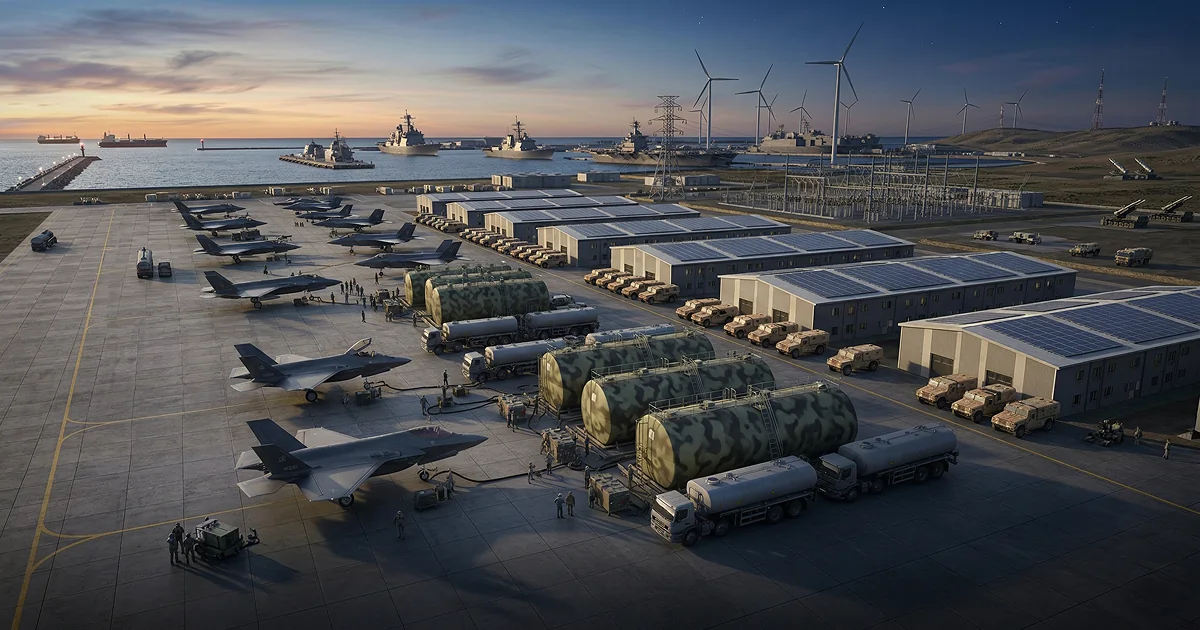
The U.S. Department of Defense is the single largest institutional energy consumer on the planet — spending over $20 billion per year on fuel and electricity to power everything from fighter jets to forward operating bases.
The Military's Energy Appetite
The U.S. military consumes roughly 85 million barrels of fuel annually — more than most countries — and uses over 30 terawatt-hours of electricity at its 500+ installations worldwide. The Air Force alone accounts for about half of all military fuel consumption, driven by jet fuel for fighter aircraft, bombers, and transport planes.
A single aircraft carrier consumes about 100,000 gallons of fuel per day at full speed. An armored division on the move can burn through 600,000 gallons daily. In remote combat zones, fuel convoys are among the most dangerous and expensive logistics operations, costing as much as $400 per gallon when delivery costs are included.
Energy Consumption by Branch
| Branch | % of DoD Energy Use | Primary Consumers |
|---|---|---|
| Air Force | ~50% | Jet fuel for aircraft, base operations |
| Navy | ~25% | Ship propulsion, carrier groups, aviation |
| Army | ~15% | Ground vehicles, forward bases, generators |
| Marines | ~5% | Expeditionary operations, vehicles |
| Other (DLA, agencies) | ~5% | Logistics, facilities, research |
Military Installations: Mini Cities
The DoD manages over 500 installations that function like small cities, with housing, hospitals, data centers, training facilities, and hangars. Fort Hood (now Fort Cavazos) in Texas is one of the largest, covering 340 square miles and housing 50,000+ soldiers plus families. Its annual electricity bill exceeds $30 million.
Key base energy facts:
- Fort Cavazos (TX) — 340 sq mi, 50,000+ soldiers, $30M+ annual electricity
- Fort Liberty (NC) — 251 sq mi, largest Army base by population
- Naval Station Norfolk (VA) — World's largest naval station, powers an entire carrier strike group fleet
- Edwards Air Force Base (CA) — 470 sq mi, hosts massive solar arrays alongside test ranges
The Push Toward Renewable Energy
The military's interest in renewables isn't just environmental — it's strategic. Dependence on fuel supply lines creates vulnerabilities. Solar panels on a forward base don't require convoys. A microgrid can keep critical systems running when the commercial grid goes down.
Major military renewable initiatives include:
- On-base solar farms. The DoD has installed over 1 GW of solar capacity across military installations. Nellis Air Force Base in Nevada hosts a 19 MW solar array covering 140 acres.
- Microgrids for energy security. Bases are building islanded microgrids that can disconnect from the commercial grid and operate independently using solar, batteries, and backup generators during attacks or natural disasters.
- Nuclear-powered vessels. The Navy operates 11 aircraft carriers and 72 submarines powered by nuclear reactors, providing virtually unlimited range without refueling.
- Tactical solar and portable power. Marines and Army units deploy flexible solar panels, portable battery packs, and hybrid generators to reduce fuel needs at forward positions.
- Alternative fuels testing. The Navy has tested biofuel blends in its ships and aircraft ("Great Green Fleet"), and the Air Force has certified all aircraft to fly on sustainable aviation fuel (SAF) blends.
Energy Security as National Security
For the military, energy isn't just a cost — it's a strategic vulnerability. Every gallon of fuel that must be trucked or flown to a forward base puts service members at risk. The DoD estimates that one casualty occurred for every 24 fuel convoys in Afghanistan, making fuel the deadliest supply chain in combat operations.
This reality drives the military's aggressive investment in energy independence: solar power at bases, battery storage for resilience, nuclear propulsion for ships, and eventually electric or hybrid tactical vehicles.
Related Articles
- Power Plants in the U.S.
- 50 Surprising Facts on Energy Consumption
- NFL Stadiums & Energy Costs
- Guide to Rooftop Solar Panels
- How Much Electricity Do Data Centers Use?
Sources
- Department of Defense — Annual Energy Management and Resilience Report — acq.osd.mil
- U.S. Energy Information Administration — eia.gov
- Congressional Research Service — DoD Energy Reports — crsreports.congress.gov