


















Cuba Electricity: 2026 Crisis, Grid Overview & History
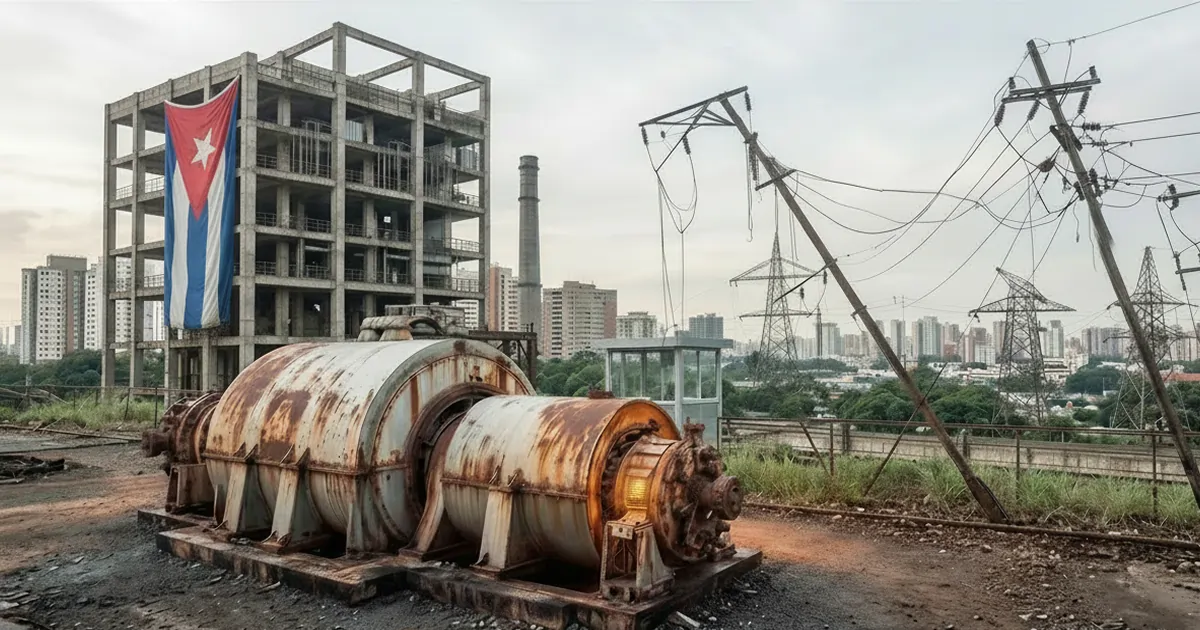
Cuba is in the worst electricity crisis in its history. Since late 2024, the island has experienced repeated total grid collapses, rolling blackouts lasting 18 or more hours per day, and a fuel shortage that has left its aging power plants unable to meet even half of the country’s electricity demand.
This page covers the latest situation on the ground, then steps back to explain how Cuba’s electricity system works, how it was built, and how it arrived at the breaking point — from early electrification in the 1880s through the Soviet era, the Special Period, and today’s crisis.
Latest Update: April 2026
As of Easter Sunday (April 5, 2026), Cuba’s National Electric System (SEN) was generating roughly 1,278 MW at evening peak against a maximum demand of approximately 3,000 MW — a deficit of over 1,700 MW. Nine thermal power plant units were out of service due to breakdowns and maintenance, with 450 MW of thermal capacity offline. Millions of Cubans are going without electricity for 18 or more hours per day.
The first quarter of 2026 has been devastating. The grid collapsed completely twice in March alone — on March 5 and again on March 16, the latter triggered by a boiler leak at the Antonio Guiteras plant in Matanzas. That blackout lasted 29 hours and 29 minutes. Deficits throughout Q1 ranged between 1,500 and nearly 2,000 MW, with the worst day reaching 1,990 MW on March 3.
The immediate cause is fuel. Oil imports dropped to effectively zero in January 2026 for the first time since 2015, after the U.S. cut off Venezuelan shipments and Mexico suspended planned exports. Only two small oil-carrying vessels reached the island in Q1 2026. Russian shipments have continued but cover only 7–10 days of total consumption.
Timeline of Major Grid Events (2024–2026)
| Date | Trigger | Scope |
|---|---|---|
| February 2024 | Multiple plant failures | Widespread blackouts |
| March 2024 | Grid overload | Extended rolling outages |
| October 2024 | Guiteras shutdown | Total national grid collapse |
| December 2024 | Guiteras automatic trip | Total national collapse; work & schools suspended |
| September 2025 | False boiler signal at Guiteras | Second massive blackout of 2025 |
| March 5, 2026 | Grid disconnection | Total collapse; restored after major blackout |
| March 16, 2026 | Guiteras boiler leak | Total collapse; 29-hour blackout, Camagüey to Pinar del Río |
| April 1–5, 2026 | Ongoing fuel shortage | Deficit exceeds 1,700 MW; 18+ hrs daily blackouts |
Cuba’s Electricity System: How It Works
Cuba’s electricity system is centrally controlled by Unión Eléctrica (UNE), a state-owned enterprise under the Ministry of Energy and Mines. UNE handles all generation, transmission, and distribution on the island. There is no private electricity market, no independent power producers, and no competitive retail — the government is the sole provider.
Generation
Over 90% of Cuba’s electricity comes from oil-fired thermoelectric plants.6 The country operates 16 major thermal generating stations, most built between the 1960s and 1980s with Soviet, Japanese, and Czech technology. The total installed generation capacity is approximately 3,000 MW, but decades of wear have reduced effective (dependable) output to well below 2,000 MW on a good day. Cuba’s pre-crisis peak demand was roughly 3,500 MW, though current demand has fallen to approximately 3,000 MW as economic activity has contracted.
The remaining generation comes from a growing fleet of solar parks (contributing about 560 MW at peak as of early 2026), a small number of diesel and gas turbine distributed generators, and minimal hydroelectric capacity.
Major Power Plants
| Plant | Location | Built | Technology | Capacity |
|---|---|---|---|---|
| Antonio Maceo (Renté) | Santiago de Cuba | 1966–1984 | Soviet | ~450 MW |
| Antonio Guiteras | Matanzas | 1988 | Japanese / Czech | ~330 MW |
| Máximo Gómez (Mariel) | Artemisa | 1980s | Soviet | ~300 MW |
| Carlos Manuel de Céspedes | Cienfuegos | 1955 (expanded) | Mitsubishi (Japan) | ~316 MW |
| Diez de Octubre | Nuevitas | 1960s–1970s | Soviet | ~750 MW (nameplate) |
Note: Nameplate capacities reflect original design ratings. Most plants operate well below these figures due to age, breakdowns, and mothballed units. The Diez de Octubre plant, for example, has six 125 MW units on paper but only two are currently active, producing roughly 150 MW combined.
These plants were designed for operational lifespans of roughly 100,000 hours. Most have far exceeded that mark. The Antonio Maceo plant operates at only about 65% of its installed capacity due to mechanical fractures in main vapor lines. Across the system, Cuba’s thermoelectric plants operate at an average of just 34% of capacity.6
Transmission and Distribution
Cuba’s national grid connects the island from Pinar del Río in the west to Santiago de Cuba in the east through a 110 kV and 220 kV transmission network. The system is highly centralized — when a single large plant like Guiteras trips offline, the frequency drop can cascade through the entire network and trigger automatic disconnections across the island. This vulnerability to cascading failures is a defining feature of the Cuban grid and a major reason why individual plant outages regularly become national blackouts.
Fuel Supply
Cuba produces only a small amount of crude oil domestically (roughly 40,000–50,000 barrels per day of heavy crude, much of it unsuitable for power generation without blending). The country depends heavily on imported fuel — historically from Venezuela through a subsidized barter arrangement, and to a lesser extent from Mexico and Russia. This dependence on a single fuel source from a small number of geopolitical allies has left Cuba’s electricity supply acutely vulnerable to external disruptions.
A History of Electricity in Cuba
Early Electrification (1889–1920s)
Cuba was among the first countries in Latin America to adopt electric power. Arc lighting was introduced in Havana in 1889, and within a few years electric streetcars and interurban railways followed. By 1914, the Tallapiedra power plant in Havana had 37.5 MW of capacity and was generating approximately 40,000 MWh per year. Early electricity service was concentrated in Havana and a handful of larger cities, supplied by small private companies.
The Cuban Electric Company (1927–1959)
In 1927, the Compañía Cubana de Electricidad was established as a subsidiary of the American & Foreign Power Company (A&FP), a U.S.-based utility holding company. By 1928, it had consolidated a near-monopoly on Cuban electricity service, operating 8 major power plants, 135 MW of installed capacity, and 4,500 km of transmission and distribution lines.
Under this arrangement, electrification expanded but remained heavily tilted toward Havana and urban areas. By the time of the revolution in 1959, installed capacity had reached 397 MW, but only about 56% of Cubans had access to electricity. Rural areas were largely unserved.
Nationalization and the Soviet Era (1959–1991)
After the 1959 revolution, the new government nationalized the Cuban Electric Company in 1960 and placed the electricity system under state control. The Soviet Union became Cuba’s primary economic partner, supplying cheap oil through non-commercial barter agreements (Cuban sugar and nickel in exchange for Soviet petroleum).
With reliable Soviet fuel, Cuba embarked on an ambitious electrification campaign. The government built a network of thermoelectric plants across the island — the same plants that form the backbone of the grid today. By the late 1980s, over 95% of Cuban households had electricity access, a rate comparable to many developed countries. Installed capacity grew to approximately 3,000 MW.
But the system was built on a single assumption: that cheap Soviet oil would keep flowing indefinitely.
The Special Period (1991–2000s)
When the Soviet Union collapsed in 1991, Cuba lost its primary source of oil, trade, and economic support almost overnight. The impact on the electricity sector was immediate and severe. Without fuel, power plants couldn’t run. Blackouts of 16 or more hours per day became routine across the island. GDP fell by an estimated 35% between 1990 and 1993.
This era — known as the “Special Period in Time of Peace” — forced Cuba into a set of survival measures: energy rationing, the shutdown of factories, a pivot toward tourism for hard currency, and a scramble to find new oil suppliers. Venezuela, under Hugo Chávez, eventually stepped in, beginning subsidized oil shipments to Cuba in 2000 under the Convenio Integral de Cooperación. Cuba sent doctors and teachers to Venezuela in exchange for roughly 100,000 barrels of oil per day at its peak.
Partial Recovery (2000s–2023)
Venezuelan oil allowed Cuba to stabilize its electricity supply, though it never fully modernized its grid. The government launched the “Revolución Energética” in 2006, distributing millions of energy-efficient appliances and installing distributed diesel generators across the island to reduce the load on aging centralized plants. Blackouts became less frequent, though the underlying infrastructure continued to deteriorate.
As Venezuela’s own economy unraveled in the 2010s, oil shipments to Cuba declined. By 2023, Venezuela was shipping well below the volumes Cuba needed to fully power its grid. The stage was set for the current crisis.
The Crisis (2024–Present)
Beginning in early 2024, Cuba’s electricity system entered a period of cascading failures. Multiple thermoelectric plants broke down simultaneously, fuel reserves dwindled, and the grid began collapsing entirely — not once, but repeatedly. The October 2024 collapse left the entire island without power. Two more total collapses followed in December 2024 and March 2026.
The crisis represents the most severe living conditions on the island since the Special Period. The difference is that in the 1990s, Cuba’s plants were younger and could be restarted once fuel arrived. Today, the plants themselves are failing.
Why Cuba Keeps Losing Power
Cuba’s electricity crisis has three reinforcing causes: aging infrastructure, fuel dependence, and geopolitics. None alone explains the situation. Together, they do.
Aging Infrastructure
Cuba’s 16 thermoelectric plants were built for operational lifespans of roughly 100,000 hours. Most have exceeded that by a wide margin. As of early 2026, eight were offline due to breakdowns and fuel shortages. The plants that remain operational run at an average of just 34% of their rated capacity.
The total installed generation capacity is approximately 3,000 MW, but effective output rarely exceeds 2,000 MW — against a maximum demand of roughly 3,000–3,500 MW. That structural gap means Cuba is short 1,500 MW or more on a normal day, and the deficit approaches 2,000 MW when major plants go down. A March 2026 report by the Cuba Study Group estimates that at least $6.6 billion in new generation investment alone would be needed to close the gap — not including transmission, distribution, or storage modernization, which could push the total to $8–$10 billion.5
Oil Dependence
Even if every plant were in perfect condition, they cannot run without fuel. Cuba’s oil imports fell 35% in the first ten months of 2025 compared to 2024. Imports from Venezuela dropped nearly 15%, while Mexican imports declined 73%. By January 2026, oil imports fell to zero for the first time since 2015. Only two small oil-carrying vessels reached the island in the first quarter of 2026.
Geopolitics
The Cuban government has long argued that the U.S. economic embargo, in place since 1960, has severely constrained its ability to modernize its energy infrastructure and access international financing and technology.1 In January 2026, the government cited the Trump administration’s tightening of sanctions — including measures affecting Venezuelan oil shipments — as the primary trigger for the latest fuel crisis, describing it as an “oil blockade.”2
The U.S. government maintains that its sanctions are a response to Cuba’s human rights record and form part of a longstanding policy.3
Independent analysts note that both the cumulative effects of the embargo and domestic policy decisions — including limited energy diversification and heavy reliance on subsidized oil from Venezuela — have contributed to the current vulnerability of the system.4
Both of these things can be true at the same time. Cuba’s grid was fragile long before the 2026 oil cutoff, and the oil cutoff has made a fragile situation catastrophic.
The Humanitarian Cost
Whatever the political debate, the human impact is not in dispute.
“Humanitarian pressures are growing” as energy shortages compound existing challenges around food security, healthcare access, and emigration.
— United Nations, February 2026
The Economic Toll
The electricity crisis has devastated what remains of Cuba’s formal economy. Tourism — one of the island’s few sources of hard currency — has been hit hard as hotels run on expensive, unreliable generators or not at all. Food processing and cold-storage facilities lose inventory during prolonged outages. Manufacturing and agriculture, already under strain, have seen output collapse alongside the grid.
The crisis has also accelerated emigration. Hundreds of thousands of Cubans have left the island since 2022, driven in part by deteriorating living conditions that the energy crisis has intensified.
Cuba’s Energy Transition
Cuba is not standing still, though the scale of the challenge far outpaces the pace of investment.
Solar Expansion
The most significant initiative is a China-backed program to install 92 solar parks by 2028, with a combined capacity exceeding 2,000 megawatts. In February 2025, President Miguel Díaz-Canel inaugurated the first park. China has donated 22 solar parks (capable of generating about 120 MW) and provided technology, materials, and expertise for others.
As of early 2026, 34 solar parks were synchronized with the national grid, contributing approximately 560 MW at peak capacity. The original target was 55 parks online by end of 2025, generating 1,200 MW collectively. Cuba invested over $1 billion in the program, much of it from domestic resources, with at least 18 million euros from the European Union. The stated goal is 24% renewable electricity generation by 2030, up from less than 5% today.
Limitations
Despite the progress, the solar expansion has had limited real-world impact on the broader crisis. Solar power helps with daytime peak demand but does nothing for evening and nighttime load — precisely when residential demand is highest. Without large-scale battery storage, solar alone cannot prevent the cascading grid failures that occur when a major thermal plant trips offline.
The government estimates that achieving a full energy transition would require $8–$10 billion in investment over the next decade — a sum that dwarfs what has been committed so far. And the solar program addresses only new generation capacity; it does not solve the underlying problem of aging transmission and distribution infrastructure.
How Cuba Compares
Cuba’s crisis is unusually severe by global standards, but it is not without parallel. Electricity infrastructure failures tend to follow a common pattern: aging systems, fuel dependence, underinvestment, and an external shock that pushes a fragile grid past its breaking point.
| Event | Year | People Affected | Root Cause |
|---|---|---|---|
| Cuba grid collapses | 2024–2026 | ~10 million | Fuel shortage + aging infrastructure |
| Puerto Rico (Hurricane Maria) | 2017 | 3.4 million | Hurricane + aging infrastructure |
| Texas (Winter Storm Uri) | 2021 | 10+ million | Extreme weather + grid isolation |
| Lebanon rolling blackouts | 2020–present | ~5 million | Fuel shortage + fiscal collapse |
| South Africa load shedding | 2023–2024 | ~60 million | Aging coal plants + underinvestment |
The comparison to Puerto Rico after Hurricane Maria is particularly instructive. Puerto Rico’s grid was also aging, underfunded, and overly centralized. When Hurricane Maria destroyed it in 2017, full restoration took 11 months. The lesson drawn from that disaster — that centralized, single-fuel grids are inherently fragile — applies directly to Cuba.
Lebanon offers perhaps the closest structural parallel. Like Cuba, Lebanon’s crisis stems from fuel dependency, fiscal constraints, and political dysfunction rather than a single weather event. Lebanese residents have endured years of 20+ hour daily blackouts and have increasingly turned to private generators and rooftop solar — a pattern now emerging in Cuba as well.
For context, Cuba’s situation also stands in contrast to deregulated electricity markets like those in the United States, where fuel diversity, competitive generation, and market incentives create multiple layers of resilience. Even after severe events like Winter Storm Uri in Texas, the combination of a competitive market and diverse generation fleet (wind, gas, solar, nuclear) enabled faster recovery and regulatory reform. Cuba’s state-controlled, single-fuel system lacks these mechanisms entirely.
What Comes Next
Cuba’s electricity crisis has no quick fix. Even if fuel imports resume tomorrow, the grid’s structural deterioration means blackouts would continue at some level. And even if every planned solar park comes online on schedule, the 2,000 MW of new capacity will take years to build out and still needs battery storage to serve nighttime demand.
In the near term, the trajectory depends heavily on two factors largely outside Cuba’s direct control: whether fuel shipments resume at meaningful volumes, and whether international investment (particularly from China and Russia) accelerates or stalls.
In the longer term, Cuba’s experience may become a case study in what happens when a national grid is built on a single fuel source, maintained at subsistence levels, and then subjected to a supply shock. It is a pattern that has played out before — in Puerto Rico, in Lebanon, in South Africa — and will almost certainly play out again.
What makes Cuba’s situation distinct is the sheer totality of the failure. This is not rolling blackouts or regional outages. It is a complete, repeated collapse of the national grid serving an entire island nation. For the 10 million people living through it, the political debates are secondary to a much simpler reality: the lights are off, the water isn’t running, and no one can say when either will come back.
Sources & Notes
- The United Nations General Assembly has voted annually since 1992 to condemn the U.S. embargo and its economic impact on Cuba, including constraints on infrastructure investment and access to financing. See: UN General Assembly, October 2024.
- Cuba’s government statements on the 2026 fuel crisis and “oil blockade”: Reuters, “Cuba says power grid back online, blames US oil blockade for blackout,” March 5, 2026.
- U.S. government position on Cuba sanctions: U.S. Department of State, Cuba Sanctions.
- Independent analysis of combined factors: Cuba Study Group, “Without Power, There Is No Country,” March 2026. Also: Reuters, “Cuba restores power after 29-hour blackout,” March 17, 2026.
- Grid modernization cost estimate of $6.6 billion (generation only): Cuba Study Group report (see note 4). The $8–$10 billion total figure, including transmission and distribution, is cited in: CiberCuba, “Lack of investment and obsolete plants,” March 26, 2026.
- Plant capacity data, 34% average utilization rate, and generation mix: Unión Eléctrica (UNE), Historia; Environmental Defense Fund, “The Cuban Electric Grid” (PDF); CiberCuba, “Blackouts reach 1,800 MW this Easter Sunday,” April 5, 2026.