U.S. Data Center Power Consumption Map
How much electricity do America's 4,500+ data centers use — and what does it mean for your rates?
U.S. Data Center Power Map
Explore data center power consumption and facility density across all 50 states. Hover for details, click to see electricity rates.
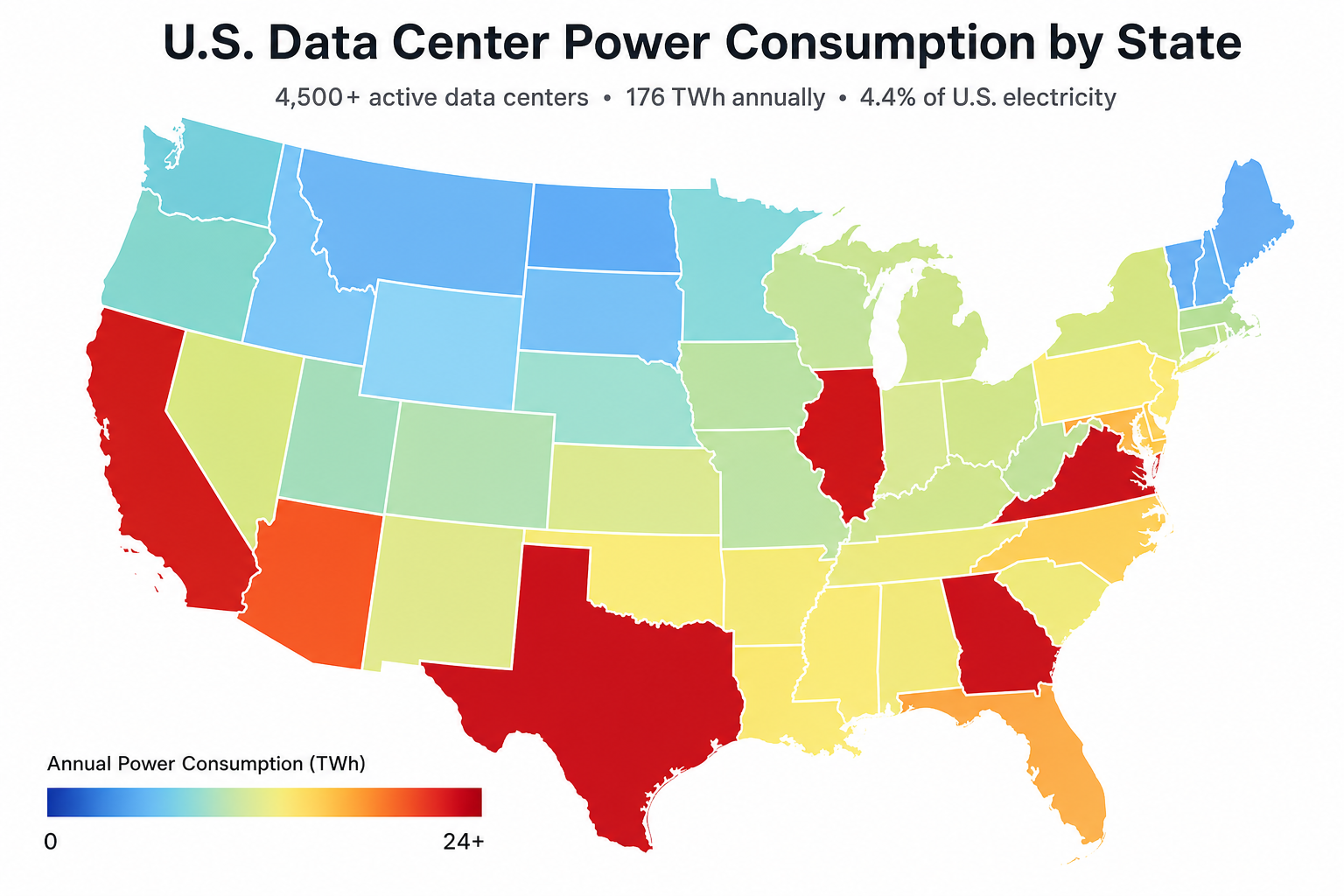
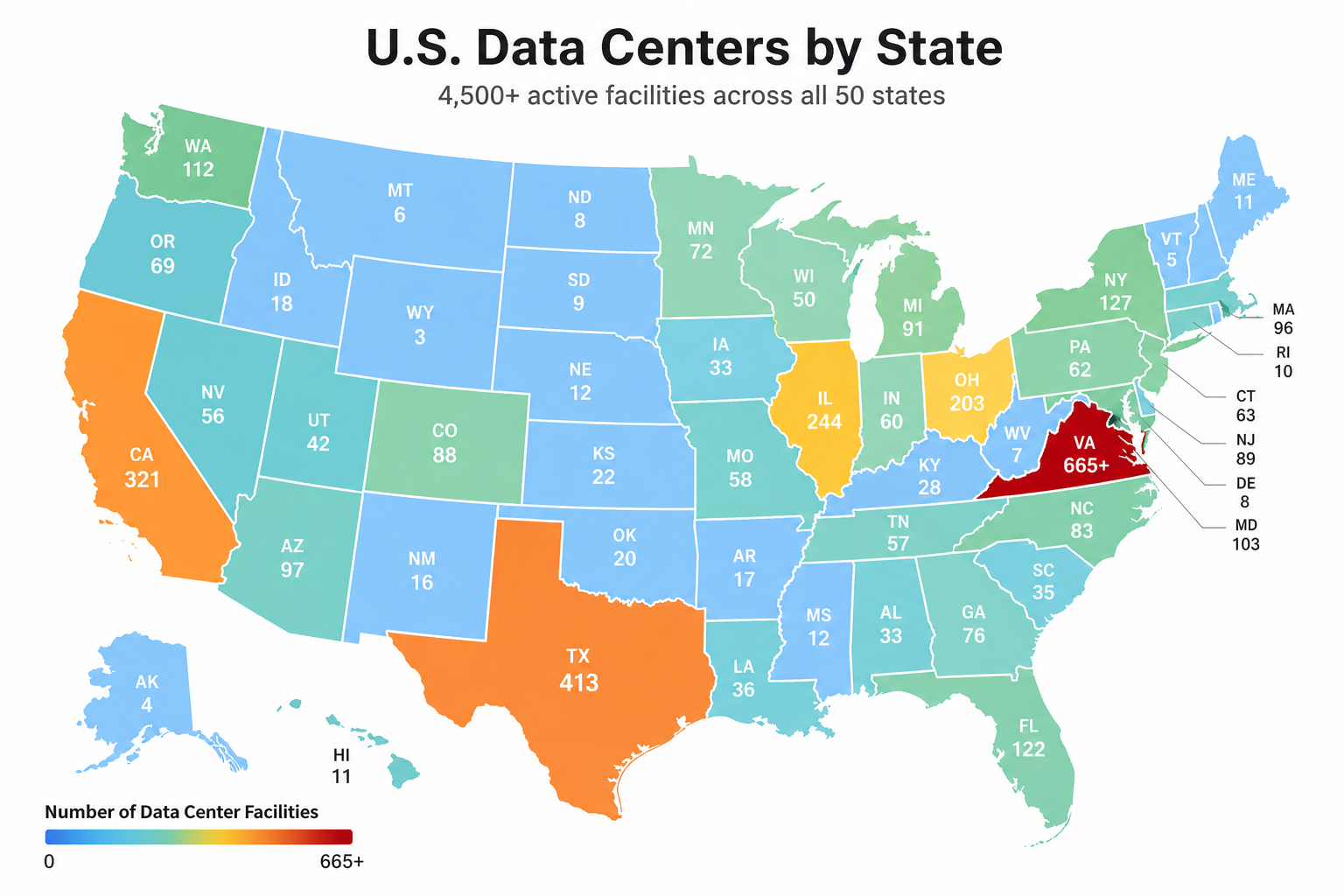
Data Centers by State
All 50 states ranked by power consumption. Click headers to sort, or search by state or operator.
| # ▲ | State | Data Centers | TWh/Year | Major Hubs & Operators |
|---|
What Are the Largest Data Center Projects Under Construction?
Over 700 data centers are actively under construction across 38 states. Below are the largest individual projects announced or underway — representing hundreds of billions in investment and tens of gigawatts of new capacity.
How Fast Is Data Center Power Demand Growing?
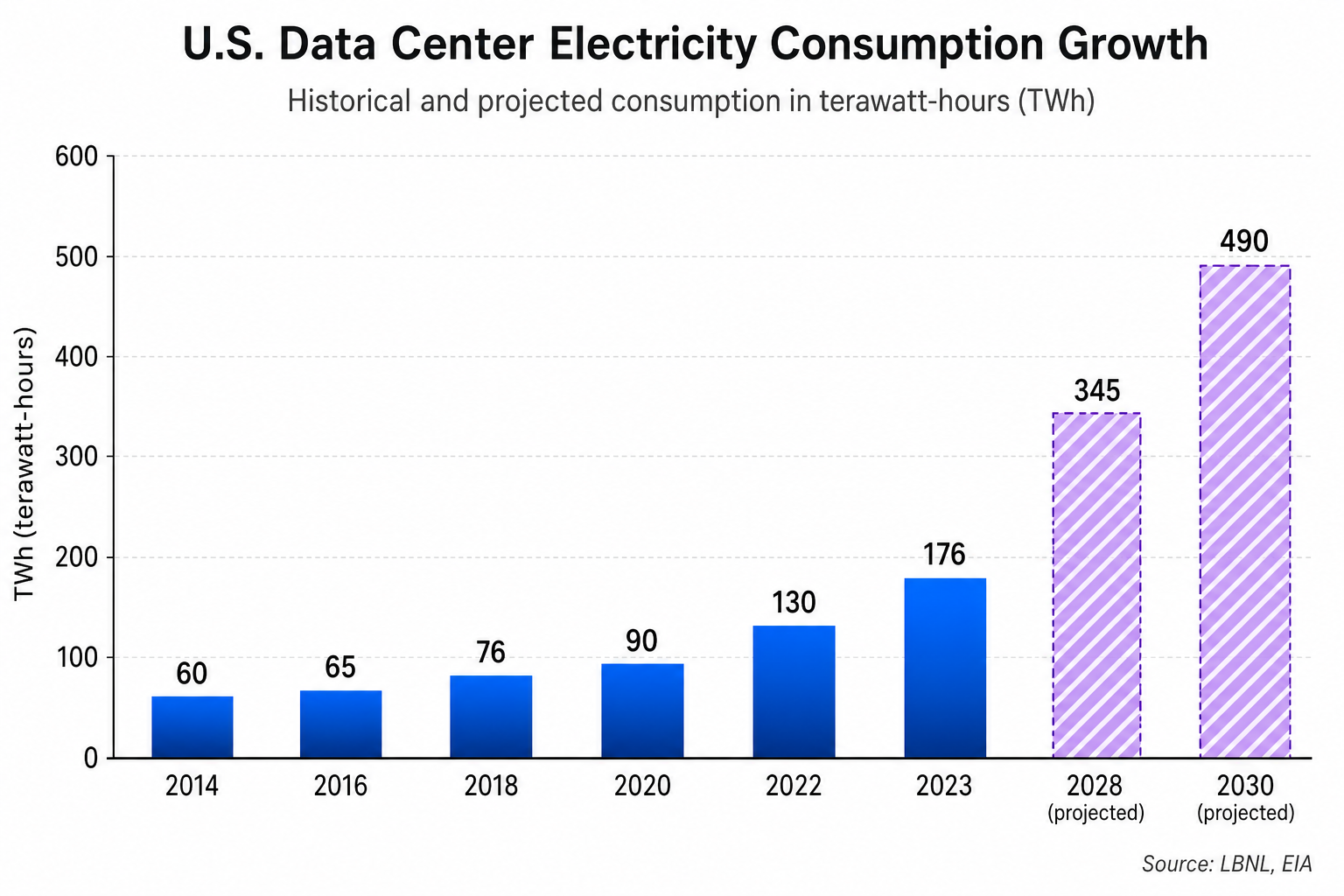
U.S. data center electricity demand has tripled in the past decade — and is projected to double again by 2028. This has direct consequences for residential electricity rates and commercial electricity rates nationwide.
Do Data Centers Raise Electricity Rates?
Data center growth is reshaping electricity markets across the country. See how rates compare in deregulated vs. regulated states on our energy deregulation map.
In Virginia, data centers now consume more than 1 in 4 kilowatt-hours of the state's electricity — an estimated 32 TWh out of 128 TWh total in 2023, per an EPRINC analysis. (At Dominion Energy specifically, data centers accounted for 21% of sales as of late 2022.) That kind of demand can strain the grid — and when utilities build new infrastructure to keep up, everyone's rates can go up.
Counterpoint: Dominion Energy has stated that data centers "do not currently have an outside influence on customer energy bills." Virginia's Joint Legislative Audit and Review Commission (JLARC) agreed in a December 2024 study that data centers are currently paying their fair share — but warned residential customers could begin bearing some costs if changes aren't made. Dominion has since created a dedicated rate class (GS-5) for data center customers over 25 MW.
In power-rich areas like West Texas and Indiana, the opposite happens. More large customers sharing fixed grid costs can lower rates for residents. Amazon's Indiana project alone is expected to save local households $1 billion over 15 years, with NIPSCO confirming Amazon will cover all infrastructure build-out costs without passing expenses to existing customers.
How Much Water Do Data Centers Use?
Water claims around data centers have become highly politicized. Some are legitimate concerns; others are misleading statistics that have been repeated uncritically for years. Here's what the evidence actually says.
This claim is a misreading of a UC Riverside study by Shaolei Ren, which found that 20–50 ChatGPT queries use about 500 ml — not one query. That works out to roughly 10–25 ml per query (a few teaspoons). OpenAI CEO Sam Altman put the figure even lower at ~0.32 ml per query (~1/15th of a teaspoon), though he didn't cite a source. The real number depends on the data center's cooling method and location, but "a bottle per query" was never what the research said.
Many widely-cited figures combine "direct" on-site cooling water with "indirect" water consumed upstream by power plants generating the data center's electricity. According to HyperFRAME Research, roughly 80% of a data center's total water footprint comes from the power grid, not the facility itself. That's real water, but attributing it to "the data center" is like blaming your house for the water used at the power plant that keeps your lights on. Direct U.S. data center water use is approximately 17 billion gallons per year — about 0.3% of public water supply (AEI).
Nationally, data center water use is a rounding error — but national averages mask local strain. In The Dalles, Oregon, Google's water use grew 316% while the town's population grew 12%. That's a real impact. Drought, aging infrastructure, and agriculture all contribute — but two-thirds of new hyperscale campuses built since 2022 are in high water-stress counties, and 1 in 5 servers sit in water-stressed watersheds. The concern isn't about the national picture; it's about where the water is being drawn.
Google replenished 4.5 billion gallons of water in 2024. Microsoft has invested $34 million+ in 76 replenishment projects globally, cut potable water use 97% at its Quincy, WA facility, and is now building zero-water-evaporation data centers using closed-loop liquid cooling. Industry-wide, water usage effectiveness has improved 39% since 2021. Modern facilities using closed-loop cooling operate at less than 0.2 L/kWh, compared to 20 L/kWh for traditional power generation. The trajectory is clearly toward water-neutral operations.
Frequently Asked Questions
Know about a data center we're missing?
Hundreds of small and mid-size facilities are being proposed across the country. If you know about one that isn't listed here, send us a tip and we'll add it to our tracker.