Winter Shutoff Rules in Every State
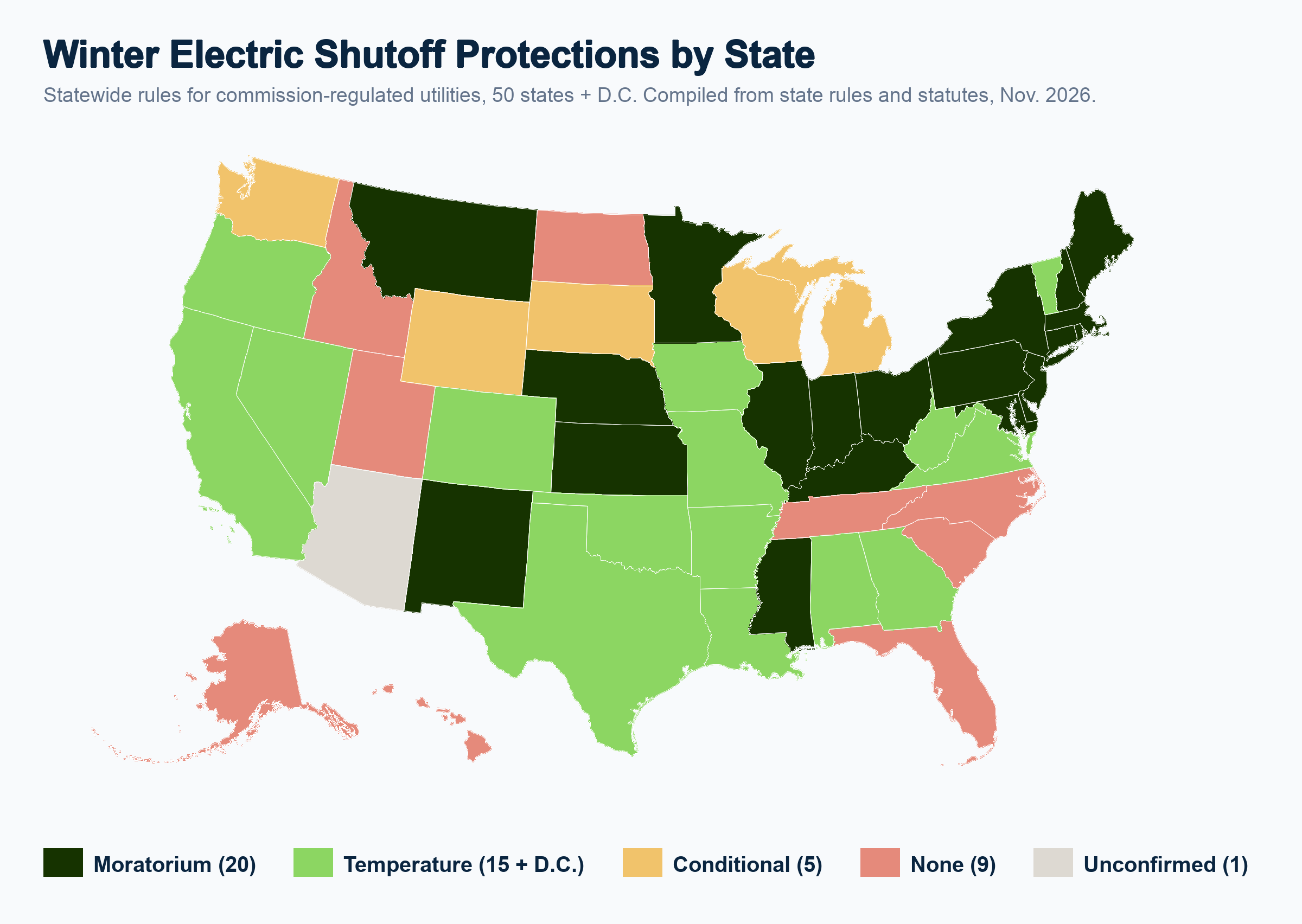
- Moratorium 20
- Temperature 15
- Conditional 5
- None 9
- Not confirmed 1
In most U.S. states, your electricity can still be shut off in winter. Twenty states have a winter shutoff moratorium, but most cover only households that qualify by income or hardship, or that sign up for a payment plan. Fifteen other states block shutoffs only on days when freezing weather is forecast, and nine states have no statewide winter protection at all.
Got a shutoff notice? Call your utility before the date on the notice and ask which winter protection you qualify for.
What to doKey takeaways
- A winter moratorium rarely covers everyone. Only Delaware’s December 21 to January 1 window and New York’s two-week holiday window apply to all households.
- Most temperature rules use a forecast of 32°F or colder. Vermont’s is the lowest (below 10°F), and Delaware and Kansas use 35°F.
- Most states require 10 to 15 days of written notice, and 44 states let a medical certificate delay a shutoff, most often for 30 days.
- Shutoffs spike just before and just after winter protection. In Pennsylvania, 98% of 2026’s electric shutoffs through September came after the winter rule ended.
- These rules usually don’t cover electric co-ops or city-owned utilities.
The Four Kinds of Winter Shutoff Protection
Every state handles winter shutoffs a little differently, but the rules fall into four groups. The colors match the map above.
Winter moratorium
20 statesA set stretch of the calendar, such as November 1 to April 15, when shutoffs are barred or restricted.
Connecticut, Delaware, Illinois, Indiana, Kansas, Kentucky, Maine, Maryland, Massachusetts, Minnesota, Mississippi, Montana, Nebraska, New Hampshire, New Jersey, New Mexico, New York, Ohio, Pennsylvania and Rhode Island
Temperature rule
15 statesNo calendar window, but no shutoff on a day when freezing weather is forecast.
Alabama, Arkansas, California, Colorado, Georgia, Iowa, Louisiana, Missouri, Nevada, Oklahoma, Oregon, Texas, Vermont, Virginia and West Virginia
Conditional
5 statesWinter brings extra notice, contact or payment-plan requirements, but doesn’t ban shutoffs.
Michigan, South Dakota, Washington, Wisconsin and Wyoming
No statewide winter rule
9 statesThese states still require written notice, and most have medical protections.
Alaska, Florida, Hawaii, Idaho, North Carolina, North Dakota, South Carolina, Tennessee and Utah
Arizona is the one state we couldn’t place. The Arizona Corporation Commission’s consumer pages confirm a five-day notice and an optional six-month deferred payment plan, but the state’s code website blocked every attempt to read the termination rule itself, so we left its seasonal and medical protections blank rather than guess.
Some states use both a calendar window and a temperature rule. Illinois, Maryland, Kansas, Delaware and Mississippi are grouped as moratorium states above, but each also blocks shutoffs on freezing days.
A Winter Moratorium Rarely Covers Everyone
“Moratorium” sounds absolute, and it almost never is. Only Delaware (December 21 to January 1) and New York (two weeks around Christmas and New Year’s) have holiday windows that apply to everyone. In the rest, protection depends on who you are or what you sign up for:
- Income or energy assistance: Pennsylvania protects households at or below 250% of the federal poverty level from December 1 to March 31. Indiana covers households receiving or applying for Energy Assistance Program help, New Mexico and Nebraska cover LIHEAP households, Kentucky uses a Certificate of Need, and New Jersey covers its Winter Termination Program.
- Financial hardship: Connecticut, Massachusetts and New Hampshire protect households that show they can’t pay. New Hampshire adds arrears limits of $450 for heating accounts and $225 for others.
- A payment plan: Kansas requires a Cold Weather Rule plan, Minnesota an agreed payment plan, Maine a Special Payment Arrangement, and Mississippi an opt-in mid-winter plan at 133% of the levelized bill. Illinois utilities can’t shut off heating service in winter without first offering a plan with no more than 10% down.
- Extra procedure, not a ban: Ohio requires an additional contact 10 days before a winter shutoff. New York requires longer notice and a health-and-safety check from November 1 to April 15. Maryland lets the utility proceed if it files an affidavit that the shutoff won’t threaten anyone’s life or health.
- Dollar caps and approvals: Rhode Island’s moratorium lifts once arrears pass $500 on a heating account or $200 otherwise. Montana requires the Public Service Commission’s approval for any winter shutoff and refuses it for low-income households and households with someone 62 or older or handicapped.
In a moratorium state, find out whether you qualify before you fall behind, and enroll in whatever plan or program the rule requires.
How Cold Does It Have to Be Before Power Can’t Be Shut Off?
In temperature-rule states, the protection applies only on the forecast day, and your balance keeps growing in the meantime. Most of these states use 32°F, but not all.
| Cold trigger | States |
|---|---|
| Below 10°F | Vermont (Burlington forecast within 48 hours; below 32°F for homes with someone 62 or older) |
| 15°F | Nevada (20°F for elderly or disabled customers) |
| 20°F | Iowa, for homes heated by electricity |
| 32°F | Alabama, Arkansas, California, Colorado, Georgia, Illinois, Louisiana, Maryland, Missouri, Oklahoma, Oregon, Texas, Virginia and West Virginia |
| 35°F | Delaware (8 a.m. airport reading) and Kansas (forecast within 48 hours) |
| Freeze warning | Mississippi, when the National Weather Service has a freeze warning out for the county |
The details matter. Texas and Louisiana look back as well as forward: the previous day’s high must have stayed at or below 32°F and the forecast must hold. California looks 72 hours ahead, while Colorado and Oklahoma check the early-morning forecast on the day of the shutoff.
Twelve states also block shutoffs during extreme summer heat. Those rules aren’t covered here.
Winter Shutoff Rules by State
The statewide rules for utilities each state’s commission regulates. “Notice” is the written warning the utility must give before a shutoff. Open a state for its full rule, medical protections and the official citation.
Alabama Temperature rule 5 days
Alabama utilities cannot shut off residential electric service for nonpayment on a day the National Weather Service forecasts 32°F or colder. They must give five days’ written notice, cannot cut service after 3:30 p.m. before a day the office is closed, and must offer installment arrangements.
- Winter rule
- No shutoff on a day forecast at 32°F or colder
- Written notice
- 5 days
- Medical certificate
- Left to each utility’s tariff
- Who it covers
- Electric, gas and water utilities regulated by the Alabama Public Service Commission (not municipal systems or rural electric cooperatives)
- Official rule
- Ala. Admin. Code r. 770-X-1-.12
Alaska None 15 days
Alaska utilities must give 15 days’ written notice before shutting off power, and 30 days if someone in the home is seriously ill, elderly, disabled or on life support. Shutoffs happen only Monday to Thursday in business hours, never on a Friday or the day before a holiday, and service must be back within three working days after the bill or agreement is fixed.
- Winter rule
- No winter or temperature rule
- Written notice
- 15 days
- Medical certificate
- 15-day extension; 30-day notice for ill, elderly or disabled homes
- Who it covers
- Electric utilities regulated by the Regulatory Commission of Alaska; municipal utilities and cooperatives outside RCA jurisdiction are not covered
- Official rule
- 3 AAC 52.450
Arizona Not confirmed 5 days
Utilities regulated by the Arizona Corporation Commission must give at least five days’ written notice before a shutoff and may offer a deferred payment plan that spreads the overdue balance over up to six months. We could not confirm any seasonal, temperature or medical protection because the state’s code website blocked access to the rule text.
- Winter rule
- The state code site blocked access to the rule text
- Written notice
- 5 days
- Medical certificate
- Not confirmed
- Who it covers
- Electric utilities regulated by the Arizona Corporation Commission; Salt River Project and municipal systems are not ACC-regulated
Arkansas Temperature rule 5 days
Arkansas utilities cannot shut off residential electric service when the National Weather Service forecasts 32°F or colder in the next 24 hours. Customers get five days’ written notice, a physician’s certificate delays a shutoff for 30 days (renewable once), and a delayed payment agreement with a down payment of no more than a quarter of the bill must be offered.
- Winter rule
- No shutoff when 32°F or colder is forecast in the next 24 hours
- Written notice
- 5 days
- Medical certificate
- 30 days, renewable once
- Who it covers
- Electric and gas utilities under Arkansas Public Service Commission jurisdiction (municipal utilities and cooperatives are generally outside PSC rate regulation)
California Temperature rule 15 days
California’s large utilities cannot shut off a home when temperatures below 32°F are forecast in the next 72 hours, and must offer a 12-month payment plan before disconnecting anyone. Medical baseline customers who take the plan cannot be shut off, and households get a 15-day notice and then a 48-hour notice.
- Winter rule
- No shutoff when below 32°F is forecast within 72 hours (PG&E, SCE, SDG&E, SoCalGas)
- Written notice
- 15 days, then a 48-hour notice
- Medical certificate
- Medical baseline customers on a 12-month plan can’t be shut off
- Who it covers
- Pacific Gas & Electric, Southern California Edison, San Diego Gas & Electric and SoCalGas; not municipal utilities such as SMUD or LADWP, and not the smaller rural IOUs
Colorado Temperature rule 12 business days
Colorado utilities cannot shut off a home when the morning forecast calls for 32°F or colder within 24 hours. Written notice must go out 12 business days ahead, shutoffs happen only Monday to Thursday between 8 a.m. and 4 p.m., and a medical certificate protects the household for 90 days.
- Winter rule
- No shutoff when the morning forecast calls for 32°F or colder within 24 hours
- Written notice
- 12 business days
- Medical certificate
- 90 days, once a year
- Who it covers
- Electric utilities regulated by the Colorado PUC; municipal utilities and cooperatives outside PUC jurisdiction are not covered
Connecticut Moratorium 13 days
Connecticut’s winter moratorium keeps electricity on from November 1 to April 15 for households designated as hardship cases, and a physician’s certification of serious illness blocks a shutoff year-round. Utilities must give 13 days’ written notice and cannot shut off on a Friday, weekend, holiday or when the office is closed.
- Winter rule
- Nov 1 – Apr 15 for hardship households (state law and PURA say through May 1)
- Written notice
- 13 days
- Medical certificate
- 15 days, renewable while the illness lasts
- Who it covers
- Electric distribution companies, electric suppliers and municipal utilities furnishing electricity in Connecticut
Delaware Moratorium 14 days
Delaware bars shutoffs from December 21 to January 1 and on any morning when the airport temperature is 35°F or colder. In the heating season the utility must give 14 days’ written notice, and a physician’s statement protects a household for 120 days.
- Winter rule
- No shutoffs Dec 21 – Jan 1, or when the 8 a.m. airport temperature is 35°F or colder
- Written notice
- 14 days
- Medical certificate
- 120 days, renewable
- Who it covers
- Electric and gas utilities, including municipal and cooperative systems, serving dwelling units in Delaware
- Official rule
- 26 Del. C. § 117; 26 DE Admin. Code 3002
District of Columbia Temperature rule 15 days
D.C. utilities cannot shut off residential power on a day the National Weather Service forecasts 32°F or colder (counting wind chill), and never from 5 p.m. Thursday to 8 a.m. Monday or on a legal holiday. Customers get 15 days’ written notice, and a physician’s certificate plus a deferred payment agreement delays a shutoff 21 days, renewable once.
- Winter rule
- No shutoff when 32°F or colder is forecast, wind chill included
- Written notice
- 15 days
- Medical certificate
- 21 days, renewable once
- Who it covers
- Electric and natural gas utilities regulated by the DC Public Service Commission
- Official rule
- 15 DCMR §§ 310.3, 311.1-311.7
Florida None 5 working days
Florida utilities must give five working days’ written notice before shutting off power and cannot shut off from noon Friday to 8 a.m. Monday, or from noon before a holiday to 8 a.m. the next working day. There is no statewide cold-weather or temperature rule; each utility files its own procedure for medically essential service.
- Winter rule
- No statewide rule; FPL alone commits to no shutoffs at 32°F or colder
- Written notice
- 5 working days
- Medical certificate
- Left to each utility’s tariff
- Who it covers
- Investor-owned electric utilities regulated by the Florida Public Service Commission; municipal utilities and rural electric cooperatives set their own rules
- Official rule
- Fla. Admin. Code r. 25-6.105
Georgia Temperature rule 5 days
Georgia utilities must give five days’ written notice and cannot shut off a home between November 15 and March 15 when 32°F or colder is forecast for the next 24 hours, provided the customer signs up for an installment plan running to October. A doctor’s statement of serious illness blocks a shutoff.
- Winter rule
- Nov 15 – Mar 15: no shutoff when below 32°F is forecast, if you sign a winter installment plan
- Written notice
- 5 days
- Medical certificate
- Doctor’s statement blocks a shutoff
- Who it covers
- Electric utilities under Georgia Public Service Commission jurisdiction, including Georgia Power and EMCs subject to PSC rules
Hawaii None 15 days to pay
Hawaii’s service standards give a customer 15 days after the bill is issued to pay and require a written termination notice stating the reason, the date, and what to do to avoid it. No termination on weekends or holidays, and elderly (62+) or handicapped customers get a utility report to the commission five days before any planned termination.
- Winter rule
- No winter or temperature rule
- Written notice
- 15 days to pay
- Medical certificate
- No certificate rule
- Who it covers
- Electric and gas utilities regulated by the Hawaii Public Utilities Commission (HECO, HELCO, MECO, Kauai Island Utility Cooperative and gas utilities)
- Official rule
- Haw. Admin. Rules § 6-60-8
Idaho None 7 days
Idaho utilities must send a written notice at least seven days before a planned shutoff, a final notice three days before and at least 24 hours’ warning, and must stop the process if the customer starts a payment arrangement. Shutoffs are barred before 8 a.m., after 5 p.m., and on Fridays, weekends, legal holidays and the day before a holiday.
- Winter rule
- No winter or temperature rule
- Written notice
- 7 days, plus a 3-day final notice
- Medical certificate
- 30 days, renewable once
- Who it covers
- Investor-owned electric, gas, water and telecom utilities regulated by the Idaho PUC; municipal utilities and cooperatives are not covered
- Official rule
- IDAPA 31.21.01 (Utility Customer Relations Rules)
Illinois Moratorium 10 days
Illinois bars shutoffs of residential heating service from December 1 through March 31 unless the utility has offered a winter payment plan with no more than 10 percent down. Year-round, no shutoff when 32°F or colder is forecast for the next 24 hours, customers get 10 days’ notice, and a medical certificate protects the home for 60 days.
- Winter rule
- Dec 1 – Mar 31 unless you’re offered a winter plan with 10% or less down; no shutoff at 32°F or colder
- Written notice
- 10 days
- Medical certificate
- 60 days
- Who it covers
- Electric and gas utilities with more than 100,000 residential customers for the weather rules; all public utilities for notice, medical and winter DPA rules
- Official rule
- 83 Ill. Adm. Code 280.130, 280.135, 280.160
Indiana Moratorium 14 days
Indiana’s winter moratorium runs December 1 to March 15 but protects only households that receive or have applied for Energy Assistance Program help. Utilities must give 14 days’ written notice and postpone a shutoff 10 days for a medical statement.
- Winter rule
- Dec 1 – Mar 15 for households receiving or applying for Energy Assistance
- Written notice
- 14 days
- Medical certificate
- 10 days
- Who it covers
- Investor-owned, municipal and cooperative electric and gas utilities
- Official rule
- Ind. Code 8-1-2-121; 170 IAC 4-1-16, 4-1-16.6
Iowa Temperature rule 12 days
Iowa utilities cannot shut off a home that relies on electricity for heat when 20°F or colder is forecast for the next 24 hours, and cannot shut off a certified LIHEAP household between November 1 and April 1. Customers get 12 days’ written notice, and a physician’s verification of an especial danger to health postpones a shutoff for 30 days.
- Winter rule
- No shutoff at 20°F or colder for electric-heat homes; Nov 1 – Apr 1 for certified LIHEAP homes
- Written notice
- 12 days
- Medical certificate
- 30 days
- Who it covers
- Investor-owned electric utilities under Iowa Utilities Board jurisdiction (cooperatives and municipal utilities follow 199 IAC 27)
- Official rule
- 199 IAC 20.4(15)
Kansas Moratorium 10 days
Kansas bars shutoffs from November 1 to March 31 whenever 35°F or colder is forecast within the next 48 hours, provided the customer is on a Cold Weather Rule payment plan paying one-twelfth of the overdue amount each month. Utilities must give 10 days’ written notice and try to reach the customer the day before.
- Winter rule
- Nov 1 – Mar 31 when 35°F or colder is forecast within 48 hours, if you’re on a Cold Weather Rule plan
- Written notice
- 10 days
- Medical certificate
- Not stated on the commission page
- Who it covers
- Residential electric, natural gas and water customers of utilities under Kansas Corporation Commission jurisdiction
Kentucky Moratorium 10 days
Kentucky has no statewide temperature-based shutoff ban. From November 1 to March 31, a Certificate of Need for a household at or below 130% of the poverty level adds 30 days and a repayment schedule, and Winter Hardship Reconnection restores service for one-third of the bill or $200, whichever is less. Utilities must give 10 days’ written notice, and a medical certificate adds 30 days.
- Winter rule
- Nov 1 – Mar 31: a Certificate of Need gives low-income homes 30 more days and a repayment schedule
- Written notice
- 10 days
- Medical certificate
- 30 days, more with a payment plan
- Who it covers
- Electric and gas utilities under Kentucky Public Service Commission jurisdiction; municipal utilities are generally outside PSC rate jurisdiction
- Official rule
- 807 KAR 5:006 §§ 14, 15, 16
Louisiana Temperature rule Not confirmed
Louisiana utilities cannot disconnect a residential customer in a parish on a day when the previous day’s high stayed at or below 32°F and the forecast keeps it there for 24 hours.
- Winter rule
- No shutoff when the prior day’s high stayed at 32°F or below and the forecast holds
- Written notice
- Not confirmed
- Medical certificate
- Not confirmed
- Who it covers
- Electric and gas utilities under Louisiana Public Service Commission jurisdiction; municipal systems such as Entergy New Orleans are regulated separately
Maine Moratorium 14 days
Maine bars winter disconnections from November 15 to April 15 for households that declare a Special Payment Arrangement. Utilities must give 14 days’ written notice, cannot disconnect on Fridays, weekends, holidays or days the office is closed, and must pause a shutoff for up to 30 days on a declared medical emergency.
- Winter rule
- Nov 15 – Apr 15 for households on a Special Payment Arrangement
- Written notice
- 14 days
- Medical certificate
- 30 days, twice a year
- Who it covers
- Electric and gas transmission and distribution utilities under Maine PUC jurisdiction (CMP, Versant); municipal utilities set their own rules
- Official rule
- Maine PUC Chapter 62; 35-A M.R.S. § 704
Maryland Moratorium 14 days
Maryland bans winter shutoffs from November 1 to March 31 unless the utility files an affidavit that the termination is not a threat to life or health, and stops terminations during 32°F-or-below extreme weather periods. Notice is 14 days, and a certified serious illness or life-support need buys 30 days.
- Winter rule
- Nov 1 – Mar 31 unless the utility files a health-and-safety affidavit; no shutoff at 32°F or colder
- Written notice
- 14 days
- Medical certificate
- 30 days, more with a payment plan
- Who it covers
- Electric and gas utilities regulated by the Maryland PSC serving residential buildings
Massachusetts Moratorium 72-hour final notice
Massachusetts bans shutoffs of heating accounts from November 15 to March 15 for any customer who cannot pay because of financial hardship, and protects households with a child under 12 months. A final notice must arrive at least 72 hours before termination, shutoffs happen only Monday to Thursday between 8 a.m. and 4 p.m., and a certificate of serious illness blocks termination.
- Winter rule
- Nov 15 – Mar 15 for heating accounts facing financial hardship
- Written notice
- 72-hour final notice
- Medical certificate
- Serious-illness certificate blocks a shutoff
- Who it covers
- Investor-owned electric and gas distribution companies; municipal light plants follow the same statutory moratorium
- Official rule
- 220 CMR 25.02, 25.03; G.L. c. 164, § 124F
Michigan Conditional 10 days
Michigan’s shutdown rules give 10 days’ notice and two phone attempts, restrict shutoffs to 8-4 on days the office is open, and protect three groups from November 1 to March 31: seniors 65 and over who register, low-income households on a Winter Protection Plan, and eligible military households. A medical emergency buys up to 63 days per person and 126 per household a year.
- Winter rule
- Nov 1 – Mar 31 for enrolled seniors 65+, low-income Winter Protection Plan and military households
- Written notice
- 10 days
- Medical certificate
- 21 days at a time, up to 63 a year per person
- Who it covers
- MPSC-regulated electric and gas utilities and municipal electric utilities for the senior and winter protections
Minnesota Moratorium 30 days by mail
Minnesota’s Cold Weather Rule runs October 1 to April 30: a household that makes and keeps an agreed payment plan cannot be disconnected, and a household at or below 50 percent of state median income must be reconnected if its primary heat is cut. Utilities must give 30 days’ notice by mail (15 by personal delivery) and cannot shut off on Fridays, weekends, holidays or the day before.
- Winter rule
- Oct 1 – Apr 30: no shutoff while you keep an agreed Cold Weather Rule payment plan
- Written notice
- 30 days by mail
- Medical certificate
- Not stated in the statute
- Who it covers
- Electric and gas utilities; § 216B.097 as cited covers municipal utilities and cooperative electric associations, and the Public Utilities Commission applies the Cold Weather Rule to investor-owned utilities
Mississippi Moratorium 5 days
Mississippi gives only five days’ written notice but bars shutoffs of hardship households from December through March if they enter the mid-winter plan paying 133 percent of the levelized bill, and bars them outright when a National Weather Service freeze warning is out for the county.
- Winter rule
- Dec 1 – Mar 31 for hardship homes that opt into the mid-winter plan; no shutoff during a freeze warning
- Written notice
- 5 days
- Medical certificate
- Doctor’s statement keeps service on through winter
- Who it covers
- Electric and gas utilities under Mississippi PSC jurisdiction; electric cooperatives and municipal systems are outside the rate rules but PSC service rules cover freeze/heat warnings for affiliates
Missouri Temperature rule 10 days
Missouri’s Cold Weather Rule runs November 1 to March 31: an investor-owned utility cannot shut off heat-related service when the National Weather Service forecasts below 32°F for the next 24 hours, and customers can spread what they owe over a 12-month payment plan. Notice is 10 days by mail, with contact attempts before disconnection.
- Winter rule
- Nov 1 – Mar 31: no shutoff of heat-related service when below 32°F is forecast
- Written notice
- 10 days
- Medical certificate
- Physician’s form for registered customers
- Who it covers
- Investor-owned electric and gas utilities under Missouri PSC jurisdiction; municipal systems, cooperatives and truck-delivered propane are outside the rule
- Official rule
- 4 CSR 240-20.110 (Cold Weather Rule)
Montana Moratorium Not stated in the PSC guide
From November 1 to April 1 a Montana utility cannot shut off a residential account for nonpayment without prior PSC approval, and the Commission refuses approval when the household is at or below the poverty line, on public assistance, or has a member 62 or older or handicapped. Shutoffs happen only between 8 a.m. and noon, and a licensed health professional’s certificate also protects an account.
- Winter rule
- Nov 1 – Apr 1: shutoffs need PSC approval, which is refused for low-income, 62+ or handicapped homes
- Written notice
- Not stated in the PSC guide
- Medical certificate
- Certificate from a health professional
- Who it covers
- Investor-owned electric, natural gas and underground propane utilities under Montana PSC jurisdiction; rural electric cooperatives and delivered propane are outside it
Nebraska Moratorium 30 days
Nebraska adds 30 days to the payment period for residential gas customers from November 1 to March 31, bars any disconnection of a documented LIHEAP household in that window, and postpones a shutoff 30 days on a physician’s certificate of immediate and serious health hazard. No disconnections on weekends, holidays or days the office is closed.
- Winter rule
- Nov 1 – Mar 31: no shutoff of LIHEAP households (gas rule; most electric service is public power)
- Written notice
- 30 days
- Medical certificate
- 30 days, once per unpaid bill
- Who it covers
- Natural gas utilities under Nebraska PSC jurisdiction (electric service in Nebraska is largely public power districts and municipals, which set their own shutoff rules)
- Official rule
- 291 Neb. Admin. Code ch. 9 § 013
Nevada Temperature rule 10 days
Nevada has no winter calendar moratorium; the bar is temperature-based. A regulated utility must postpone a nonpayment shutoff whenever the National Weather Service forecast for the next 24 hours hits 15°F or lower (20°F for elderly or disabled households under NAC 704.390). Notice is 10 days, and a doctor’s statement buys 30 days.
- Winter rule
- No shutoff when 15°F or colder is forecast (20°F for elderly or disabled customers)
- Written notice
- 10 days
- Medical certificate
- 30 days, renewable
- Who it covers
- Electric and gas utilities regulated by the PUCN (Nevada Power, Sierra Pacific); rural electric co-ops and municipal systems are mostly outside
- Official rule
- NAC 704.360, 704.370, 704.375
New Hampshire Moratorium 14 days
New Hampshire’s winter period runs November 15 to March 31: a financial-hardship household with arrears under $450 (heating) or $225 (non-heating) cannot be disconnected, customers 65 and over need department approval, and notice must reach an adult in person or by phone 2 to 8 business days ahead. Written notice is 14 days, and a medical certification protects the account for 90 days to a year.
- Winter rule
- Nov 15 – Mar 31 for hardship households under the arrears limits; 65+ need state approval
- Written notice
- 14 days
- Medical certificate
- 90 days, renewable
- Who it covers
- Residential gas and electric customers of utilities under New Hampshire Department of Energy jurisdiction; rural electric cooperatives with a certificate of deregulation are exempt
New Jersey Moratorium 10 days
New Jersey bars shutoffs of Winter Termination Program households from November 15 to March 15 and requires 10 days’ written notice. Residential disconnections can happen only Monday to Thursday, 8 a.m. to 4 p.m., and never while a valid medical emergency exists. Customers facing hardship can ask for a budget plan based on ability to pay.
- Winter rule
- Nov 15 – Mar 15 for Winter Termination Program households
- Written notice
- 10 days
- Medical certificate
- No shutoff during a medical emergency
- Who it covers
- Residential gas and electric customers of New Jersey BPU-regulated utilities; municipal utilities and co-ops are outside BPU rate regulation
- Official rule
- N.J.A.C. 14:3-3A; BPU Customer Bill of Rights
New Mexico Moratorium 15 days
New Mexico requires a 15-day written notice before a residential disconnection and bars disconnection from November 15 to March 15 for LIHEAP-qualified customers who are current on any settlement or installment agreement. A medical certification from a licensed medical professional, paired with a financial certification, also blocks a shutoff.
- Winter rule
- Nov 15 – Mar 15 for LIHEAP-qualified households current on a payment agreement
- Written notice
- 15 days
- Medical certificate
- Blocks a shutoff, with a financial certification
- Who it covers
- Residential gas and electric customers of PRC-regulated utilities; cooperatives and municipals are outside the rule
- Official rule
- 17.5.410 NMAC
New York Moratorium 15 days
New York’s HEFPA gives a residential customer a written notice and 15 days to pay or make an agreement, extended to 30 days for heat-related service between November 1 and April 15, when the utility must also make a special effort to learn whether shutting off service would impair health or safety. Termination is suspended for two weeks around Christmas and New Year, and a doctor’s certification of a medical emergency keeps service on for 30 days.
- Winter rule
- No shutoffs for two weeks around Christmas and New Year’s; Nov 1 – Apr 15 longer notice and a health-and-safety check
- Written notice
- 15 days (30 for heating service in winter)
- Medical certificate
- 30 days, renewable
- Who it covers
- Residential gas, electric and steam customers of utilities under New York PSC jurisdiction (HEFPA); municipal utilities and Long Island Power Authority service are treated separately
North Carolina None 24 hours
North Carolina’s codified electric rule requires at least 24 hours’ written notice before service is cut for nonpayment, after the utility first tries to get the customer to pay. The commission’s electric rules have no statewide winter moratorium or temperature trigger, and electric membership corporations and city utilities aren’t bound by them.
- Winter rule
- No winter or temperature rule
- Written notice
- 24 hours (in the rule)
- Medical certificate
- Not in the rule
- Who it covers
- Electric utilities under North Carolina Utilities Commission jurisdiction; electric membership corporations and municipal systems follow their own policies
- Official rule
- NCUC Rule R8-20 (14 NCAC 08)
North Dakota None 10 days
North Dakota does not ban winter shutoffs. Its rules require 10 days’ written notice, bar disconnections on weekends, Fridays, state holidays, holiday eves and after noon, and let a customer postpone a shutoff up to 30 days by showing dangerous health conditions or by being 65+ or disabled. Only investor-owned utilities are bound.
- Winter rule
- No winter or temperature rule
- Written notice
- 10 days
- Medical certificate
- 30 days (also for 65+ or disabled)
- Who it covers
- Investor-owned electric and natural gas utilities under ND PSC jurisdiction (Xcel, Montana-Dakota, Great Plains, Otter Tail, Dakota Natural Gas); municipal utilities and rural electric cooperatives are not bound
Ohio Moratorium 14 days
Ohio requires at least 14 days’ notice before a residential disconnection. From November 1 to April 15 the utility must also reach the customer or another adult at the premises 10 days out, by personal contact, telephone, hand-delivered notice or mail. A medical certification blocks disconnection for 30 days, renewable twice to 90 days per household per year.
- Winter rule
- Nov 1 – Apr 15: the utility must make extra contact 10 days before a shutoff (not a ban)
- Written notice
- 14 days
- Medical certificate
- 30 days, up to 90 a year
- Who it covers
- Residential electric and natural gas customers of PUCO-regulated utilities; municipal utilities and rural electric cooperatives are outside PUCO rules
- Official rule
- Ohio Adm. Code 4901:1-18-06, 4901:1-18-05
Oklahoma Temperature rule 10 days
Oklahoma suspends disconnections when the National Weather Service forecast calls for below 32°F within 24 hours for a heating customer. The utility must give 10 days’ written notice by first-class mail, another notice two business days out, and must not disconnect on holidays or after noon on Fridays.
- Winter rule
- No shutoff when below 32°F is forecast within 24 hours, for electric-heat homes
- Written notice
- 10 days
- Medical certificate
- Life-threatening condition, with a payment plan
- Who it covers
- Electric utilities under Oklahoma Corporation Commission jurisdiction; municipal systems and electric cooperatives set their own rules
- Official rule
- OAC 165:35-21-10, 165:35-21-20, 165:35-21-21
Oregon Temperature rule 20 days
Oregon protects electric and gas customers with a 20-day notice, a second notice five days out, and a moratorium whenever the temperature is forecast below 32°F between November and March. A medical certificate blocks disconnection and forces the utility to offer a payment plan.
- Winter rule
- No shutoff when below 32°F is forecast, November through March
- Written notice
- 20 days
- Medical certificate
- Blocks a shutoff; utility must allow a payment plan
- Who it covers
- Electric and natural gas utilities regulated by the Oregon PUC; municipal utilities and cooperatives are outside PUC rules
Pennsylvania Moratorium 10 days
Pennsylvania’s winter rule bars terminating service from December 1 to March 31 to households at or below 250% of the federal poverty level, except on listed grounds. Notice is 10 days, a medical certification blocks termination for up to 30 days (renewable), and reconnection must occur within 24 hours for a valid certification or a winter termination.
- Winter rule
- Dec 1 – Mar 31 for households at or below 250% of the federal poverty level
- Written notice
- 10 days
- Medical certificate
- 30 days, renewable
- Who it covers
- Residential electric, natural gas and water customers of PUC-regulated utilities at or below 250% of the federal poverty level (winter rule); above that income the utility may terminate
- Official rule
- 52 Pa. Code §§ 56.91, 56.96, 56.100
Rhode Island Moratorium 10 days
Rhode Island bans winter terminations from November 1 to April 15 unless the arrears exceed $500 for a heat account or $200 otherwise, and its 2024 statute pushes the moratorium to May 1. Notice is 10 days, disconnections happen only 8 a.m. to 4 p.m. Monday-Thursday, and a medical certification for a seriously ill resident blocks termination.
- Winter rule
- Nov 1 – Apr 15 (May 1 under a 2024 law) unless arrears top $500 for heat or $200 otherwise
- Written notice
- 10 days
- Medical certificate
- Serious-illness certificate blocks a shutoff
- Who it covers
- Residential electric, gas and water customers of Rhode Island DPUC-regulated utilities
South Carolina None 10 days
South Carolina requires at least 10 days’ written notice before terminating residential electric service for nonpayment, with a personal contact attempt before the crew disconnects. A physician’s certificate that a shutoff would be especially dangerous to health defers termination for 31 days, renewable up to three times. No statewide cold-weather moratorium appears in Reg 103-352.
- Winter rule
- No winter or temperature rule
- Written notice
- 10 days
- Medical certificate
- 31 days, up to 3 renewals
- Who it covers
- Residential customers of South Carolina PSC-regulated electrical utilities (IOUs); electric cooperatives and municipal utilities are outside PSC rate regulation
- Official rule
- S.C. Code Regs. 103-352; S.C. Code 58-27-130
South Dakota Conditional 10 days
South Dakota gives residential customers a 20-day payment window plus at least 10 days’ notice before disconnection for nonpayment, extended by an additional 30 days between November 1 and March 31. Service may not be disconnected on a Friday, weekend or holiday, and a medical certificate postpones a shutoff for 30 days once.
- Winter rule
- Nov 1 – Mar 31 adds 30 days to the notice period
- Written notice
- 10 days, plus 30 more in winter
- Medical certificate
- 30 days, once
- Who it covers
- Customers of electric and gas utilities regulated by the South Dakota PSC; municipal utilities and cooperatives are outside PSC jurisdiction
- Official rule
- S.D. Admin. R. 20:10:20:03, :06, :10, :11
Tennessee None 7 days
Tennessee requires a written termination notice mailed at least seven days before the proposed shutoff date, stating the date service will end and the reconnection fee. A physician’s, public health officer’s or social service official’s certification of an existing medical emergency postpones termination for 30 days. Customers may name a third party to receive duplicate notices.
- Winter rule
- No winter or temperature rule
- Written notice
- 7 days
- Medical certificate
- 30 days
- Who it covers
- Residential customers of electric companies regulated by the Tennessee Public Utility Commission; TVA-served municipal and cooperative systems follow TVA/local rules
- Official rule
- Tenn. Comp. R. & Regs. 1220-04-04-.19
Texas Temperature rule 10 days
Texas retail electric customers get at least 10 days’ written notice, and the disconnection date can’t fall on a holiday or weekend. Disconnections are barred in a county during an extreme weather emergency: when the previous day’s high did not exceed 32°F and the forecast stays at or below that for 24 hours. Critical Care and Chronic Condition customers get added protection, and a deferred payment plan must be offered on request.
- Winter rule
- No shutoff when the prior day’s high stayed at 32°F or below and the forecast holds
- Written notice
- 10 days
- Medical certificate
- Critical Care and Chronic Condition designations
- Who it covers
- Residential retail electric customers of REPs and TDUs in the ERCOT competitive market and the state’s other retail choice areas
- Official rule
- 16 Tex. Admin. Code §§25.483, 25.29, 25.497
Utah None 10 days
Utah requires written notice of a proposed termination and a separate 48-hour notice before the shutoff, with good-faith attempts to reach the customer by mail, telephone or a visit. Customers with life-supporting equipment who file a verified statement get a 30-day termination notice routed through the Division of Public Utilities, and a deferred payment agreement must be offered first.
- Winter rule
- No winter or temperature rule
- Written notice
- 10 days, then a 48-hour notice
- Medical certificate
- Life-support statement; 30-day notice
- Who it covers
- Residential customers of public utilities regulated by the Utah PSC; municipal utilities and cooperatives are outside PSC jurisdiction
- Official rule
- Utah Admin. Code R746-200-7
Vermont Temperature rule 14 to 20 days
Vermont’s Rule 3.300 requires 14 to 20 days’ written notice before a residential disconnection, and between November 1 and March 31 the utility must also make three spaced phone calls (one in the evening) and a visit. Disconnection is barred when the Burlington forecast falls below 10°F in the next 48 hours, and households with a member 62 or older are protected below 32°F. A physician’s certificate buys 30 days, renewable once.
- Winter rule
- No shutoff when the Burlington forecast is below 10°F within 48 hours; below 32°F for homes with someone 62+
- Written notice
- 14 to 20 days
- Medical certificate
- 30 days, up to 3 times a year
- Who it covers
- Residential gas, electric and water ratepayers of Vermont utilities regulated by the Public Utility Commission; municipal utilities and cooperatives set their own tariffs
- Official rule
- Vt. PUC Rule 3.300, §§ 3.301-3.306
Virginia Temperature rule Set by tariff
Virginia bars electric disconnections when the forecast low is 32°F or colder, and on Fridays, weekends, state holidays and the day before a state holiday. An account must be 60 days in arrears, notice must go out by at least two methods, and the utility must offer a payment plan first. A serious medical condition delays a shutoff 15 days without the certification form and 30 days with it.
- Winter rule
- No shutoff when the forecast low is 32°F or colder
- Written notice
- Set by tariff; account must be 60 days behind
- Medical certificate
- 30 days with the form, 15 without
- Who it covers
- Residential customers of investor-owned electric utilities and electric cooperatives in Virginia
- Official rule
- Va. Code §§ 56-245.1:3, 56-245.1:4; 20 VAC 5-330-40
Washington Conditional 8 business days
Washington requires two disconnection notices: a written first notice at least eight business days ahead and a second notice at least two business days before the shutoff. Between November 15 and March 15 the notice must flag the winter low-income payment program. A medical condition or emergency postpones or reverses a disconnection for five business days.
- Winter rule
- Nov 15 – Mar 15 winter low-income payment program
- Written notice
- 8 business days, plus a 2-day notice
- Medical certificate
- 5 business days
- Who it covers
- Residential customers of investor-owned electric utilities regulated by the UTC; municipal utilities and PUDs set their own rules
- Official rule
- WAC 480-100-128, 480-100-143
West Virginia Temperature rule 10 days
West Virginia requires a written notice postmarked at least 10 days before termination plus two personal-contact attempts, the last at least 48 hours out. Service may not be cut on a day the forecast is 32°F or colder, on a Friday, weekend or holiday, or outside 8:00 a.m. to 4:00 p.m. A certified health condition, renewed every 30 days, expands the notice requirements and bars termination in some cases.
- Winter rule
- No shutoff when 32°F or colder is forecast; extra contact attempts Nov 1 – Mar 31
- Written notice
- 10 days
- Medical certificate
- 30 days, renewable
- Who it covers
- Customers of electric utilities regulated by the West Virginia PSC; municipal utilities are outside PSC rule 150-3
- Official rule
- W. Va. Code R. § 150-3-4.8
Wisconsin Conditional 10 days
Wisconsin requires at least 10 calendar days’ written notice before a residential disconnection. From November 1 to April 15, where the service provides the household’s primary heat, disconnection is a last resort and protected households - elderly, infants, seriously ill or disabled - get added protection under PSC 113.0304. A deferred payment agreement must be available first.
- Winter rule
- Nov 1 – Apr 15: shutting off primary heat is a last resort, with extra protection for elderly, infants, ill or disabled
- Written notice
- 10 days
- Medical certificate
- Medical emergency protection
- Who it covers
- Residential customers of Wisconsin electric utilities regulated by the PSC; municipal utilities and cooperatives file their own rules
- Official rule
- Wis. Admin. Code PSC 113.0301, 113.0304, 113.0404
Wyoming Conditional 7 days
Wyoming gives residential customers at least seven calendar days’ written notice before a disconnection, and from November 1 to April 30 the utility must try to make actual contact first. A health care provider’s written verification extends the disconnection date by 15 days (22 days total). Service may be cut only between 8:00 a.m. and 4:00 p.m., Monday through Thursday.
- Winter rule
- Nov 1 – Apr 30: the utility must try to reach you in person or by phone first
- Written notice
- 7 days
- Medical certificate
- 15 days
- Who it covers
- Customers of Wyoming PSC-regulated electric utilities; municipal utilities and rural electric cooperatives are outside PSC rate regulation
- Official rule
- Wyoming PSC Rules, Chapter 3, Section 9
State counts on this page don’t include Washington, D.C., which uses a temperature rule (see its row above). Where two official sources disagree, the table shows the rule text. Connecticut’s regulation ends its hardship period April 15, while the statute and PURA describe protection through May 1. Rhode Island’s rule says April 15, and a 2024 law extends it to May 1. North Carolina’s codified rule requires 24 hours’ notice, while the Attorney General’s consumer guidance describes 10 days.
When Shutoffs Actually Happen
Only five states publish residential shutoff counts by utility in a compiled report: California, Missouri, New York, Pennsylvania and Wisconsin. In the other 45 states, the numbers exist only inside individual utility filings. Add up the latest period each of the five states reports and it comes to more than 1 million residential electric and gas shutoffs, with Pennsylvania counting only nine months so far.
Two of those reports break the numbers out by month, and they show the same pattern: winter protection works while it lasts, and shutoffs pile up on either side of it.
Pennsylvania: shutoffs jump eightfold when the winter rule ends
Pennsylvania’s eight electric utilities shut off 4,632 homes for nonpayment from January through March 2026, while the winter rule protected lower-income households. In April, the first month after it expired, they shut off 37,790, eight times as many as the first three months combined. Through September, 98% of the year’s electric shutoffs came after March 31.
The year-to-date total of 228,828 is almost exactly last year’s (230,702 for the same months, down 0.8%), but individual utilities moved a lot. Duquesne Light more than doubled, from 11,710 to 24,379, and PECO rose 11.8% to 108,305, while West Penn Power fell 34.8% and Penn Power fell 36.4%.
Missouri: shutoffs peak right before the Cold Weather Rule
Missouri’s three large electric utilities that were disconnecting customers in 2025 cut off 126,723 residential meters. The busiest month was October, with 21,689, the last month before the Cold Weather Rule starts on November 1. August through October accounted for 47% of the year’s shutoffs. In December there were four.
Ameren Missouri disconnected 92,834 residential customers in 2025, about 8.4 for every 100 it serves, or roughly one in 12. That’s the highest rate among utilities where customer counts are available.
The lesson from both states: the riskiest time isn’t the middle of winter. It’s the weeks just before protection starts and just after it ends. If you’re behind, set up a payment plan now rather than waiting for spring.
Shutoffs by utility
| Utility | Period | Shutoffs | Per 100 customers |
|---|---|---|---|
| California | |||
| PG&E, SCE, SDG&E and SoCalGas (combined) | 2025 | 450,598 | — |
| Missouri | |||
| Union Electric Co. (Ameren Missouri) | 2025 | 92,834 | 8.4 |
| Evergy Metro | 2025 | 18,185 | 6.6 |
| Evergy Missouri West | 2025 | 15,704 | 5.1 |
| Empire District Electric (Liberty) | 2025 | Paused* | — |
| New York | |||
| Consolidated Edison Co. of New York | Jul 2025 – Jun 2026 | 77,401 | 2.4 |
| National Grid (Niagara Mohawk) | Jul 2025 – Jun 2026 | 23,053 | 1.5 |
| New York State Electric & Gas | Jul 2025 – Jun 2026 | 16,877 | 1.6 |
| National Fuel Gas Distribution | Jul 2025 – Jun 2026 | 8,877 | 1.7 |
| Rochester Gas & Electric | Jul 2025 – Jun 2026 | 7,970 | 1.2 |
| PSEG Long Island | Jul 2025 – Jun 2026 | 6,978 | 0.6 |
| Orange and Rockland Utilities | Jul 2025 – Jun 2026 | 4,837 | 2.2 |
| National Grid (New York City) | Jul 2025 – Jun 2026 | 4,204 | 0.3 |
| Central Hudson Gas & Electric | Jul 2025 – Jun 2026 | 2,808 | 0.9 |
| National Grid (Long Island) | Jul 2025 – Jun 2026 | 1,780 | 0.3 |
| Pennsylvania | |||
| PECO Energy | Jan – Sep 2026 | 108,305 | — |
| PPL Electric Utilities | Jan – Sep 2026 | 40,038 | — |
| Metropolitan Edison | Jan – Sep 2026 | 25,522 | — |
| Duquesne Light | Jan – Sep 2026 | 24,379 | — |
| Penelec | Jan – Sep 2026 | 14,447 | — |
| West Penn Power | Jan – Sep 2026 | 11,838 | — |
| Penn Power | Jan – Sep 2026 | 3,583 | — |
| UGI Utilities (electric) | Jan – Sep 2026 | 716 | — |
| Wisconsin | |||
| Wisconsin Electric Power Co. | 2024 | 54,079 | — |
| Wisconsin Gas | 2024 | 4,058 | — |
| Madison Gas and Electric | 2024 | 3,305 | — |
| Wisconsin Power and Light | 2024 | 2,710 | — |
| Northern States Power Co. – Wisconsin | 2024 | 335 | — |
New York figures add four quarters of the Public Service Commission’s collection data. Wisconsin figures are the year-end residential disconnection counts each utility filed in its 2024 annual report. Some New York and Wisconsin rows are gas utilities, because the commissions report gas and electric together. Per-100 rates use each utility’s reported residential customer count; Pennsylvania, Wisconsin and California don’t publish one alongside the shutoffs. *Liberty paused disconnections starting in April 2024 while it switched to a new customer billing system, according to the Missouri PSC report.
What to Do If You Get a Shutoff Notice This Winter
- Check the date on the notice. In 31 states, the utility must give 10 to 15 days of written notice. At least 15 states also bar shutoffs on Fridays, and many bar them on weekends, holidays or late in the day, so the earliest possible date may be later than you think.
- Call the utility and ask for the winter program by name. Depending on your state, it may be called the Cold Weather Rule plan (Kansas, Missouri, Minnesota), Winter Protection Plan (Michigan), Special Payment Arrangement (Maine), Winter Termination Program (New Jersey) or a winter installment agreement (Georgia).
- Get a medical certificate if someone in the home is seriously ill. Forty-four states have a medical protection. Where the rule sets a fixed period, it ranges from five business days in Washington to 120 days in Delaware; 30 days is most common.
- Apply for energy assistance. In Indiana, Iowa, Nebraska and New Mexico, receiving or qualifying for assistance is what turns on the winter protection.
- Don’t count on the weather. A temperature rule only pauses a shutoff on the forecast day. The utility can disconnect as soon as the forecast warms up.
- Call your state utility commission if the utility won’t work with you. The commission enforces these rules, and its consumer office handles complaints.
If a high bill is the root problem, see why your electric bill may be so high and how much of their income households spend on electricity in each state. Texans can check Texas electricity assistance programs.
Who These Rules Don’t Cover
State commission rules generally apply only to the utilities the commission regulates. In most states that leaves out electric cooperatives and city-owned utilities. Alabama’s rule excludes municipal systems and rural co-ops, and Arizona’s commission doesn’t regulate Salt River Project. California’s rules cover the four large investor-owned utilities but not SMUD or LADWP. In Tennessee, most households are served by TVA-supplied city utilities and co-ops that follow TVA and local rules, and in Nebraska nearly all electric service comes from public power districts that set their own shutoff policies.
A few states reach further. Delaware’s law covers municipal and cooperative systems, Indiana’s covers investor-owned, municipal and co-op utilities, Massachusetts applies its moratorium to municipal light plants, and Virginia’s statute covers electric cooperatives. If a co-op or city utility serves you, ask it for its own shutoff policy.
Frequently Asked Questions
Can my electricity be shut off in the winter?
In most states, yes. Twenty states have a winter moratorium window, but most of those protect only households that qualify by income, hardship or a payment plan. Fifteen more states block shutoffs only on days when freezing temperatures are forecast, and nine states have no statewide winter protection at all.
Which states have a winter moratorium on electric shutoffs?
Twenty: Connecticut, Delaware, Illinois, Indiana, Kansas, Kentucky, Maine, Maryland, Massachusetts, Minnesota, Mississippi, Montana, Nebraska, New Hampshire, New Jersey, New Mexico, New York, Ohio, Pennsylvania and Rhode Island. Only Delaware’s December 21 to January 1 window and New York’s two-week holiday window apply to everyone; the rest depend on income, hardship, enrollment in a payment plan or extra procedural steps.
How cold does it have to be before the power company can’t shut off my electricity?
In most temperature-rule states the threshold is a forecast of 32°F or colder. Delaware and Kansas use 35°F, Iowa uses 20°F for homes heated by electricity, Nevada uses 15°F (20°F for elderly or disabled customers), and Vermont uses a Burlington forecast below 10°F, or below 32°F for homes with someone 62 or older.
Can the electric company shut off my power on a Friday or weekend?
Not in many states. At least 15 states bar residential shutoffs on Fridays: Alaska, Colorado, Connecticut, Delaware, Idaho, Maine, Massachusetts, Minnesota, New Jersey, North Dakota, Rhode Island, South Dakota, Virginia, West Virginia and Wyoming. Florida and Oklahoma bar them from noon on Friday, and Illinois after 4 p.m. on Friday unless the utility can reconnect the same day.
How much notice does a utility have to give before shutting off power?
Usually 10 to 15 days of written notice, which is the rule in 31 states. North Carolina’s codified rule requires only 24 hours and Massachusetts requires a final notice at least 72 hours ahead, while Oregon requires 20 days and Minnesota 30 days by mail.
Does a medical certificate stop an electric shutoff?
In most states it delays one. Forty-four states have some medical protection in their rules. Where the rule sets a fixed period, it ranges from five business days in Washington to 120 days in Delaware, and 30 days is the most common.
Do winter shutoff rules apply to electric co-ops and city-owned utilities?
Usually not. State commission rules generally bind the utilities the commission regulates, which in most states excludes electric cooperatives and municipal utilities. A few states, such as Delaware and Indiana, extend their rules to co-ops and city utilities. If a co-op or city utility serves you, ask it for its own shutoff policy.
When do most electric shutoffs happen?
Right before and right after winter protection. In Missouri, 47% of 2025’s residential disconnections happened in August, September and October, just before the Cold Weather Rule began. In Pennsylvania, 98% of electric shutoffs from January to September 2026 came after the winter rule ended on March 31.
Sources
State rules are linked in each state’s row. Shutoff counts are from the California PUC, Missouri PSC, New York DPS, Pennsylvania PUC and Wisconsin PSC.